San Lorenzo de Almagro · Buenos Aires
La Butteler
La Butteler is the barra brava of San Lorenzo: the origin of the name, leaders since 1997, the Atlanta fight at the 2026 World Cup and admission bans.

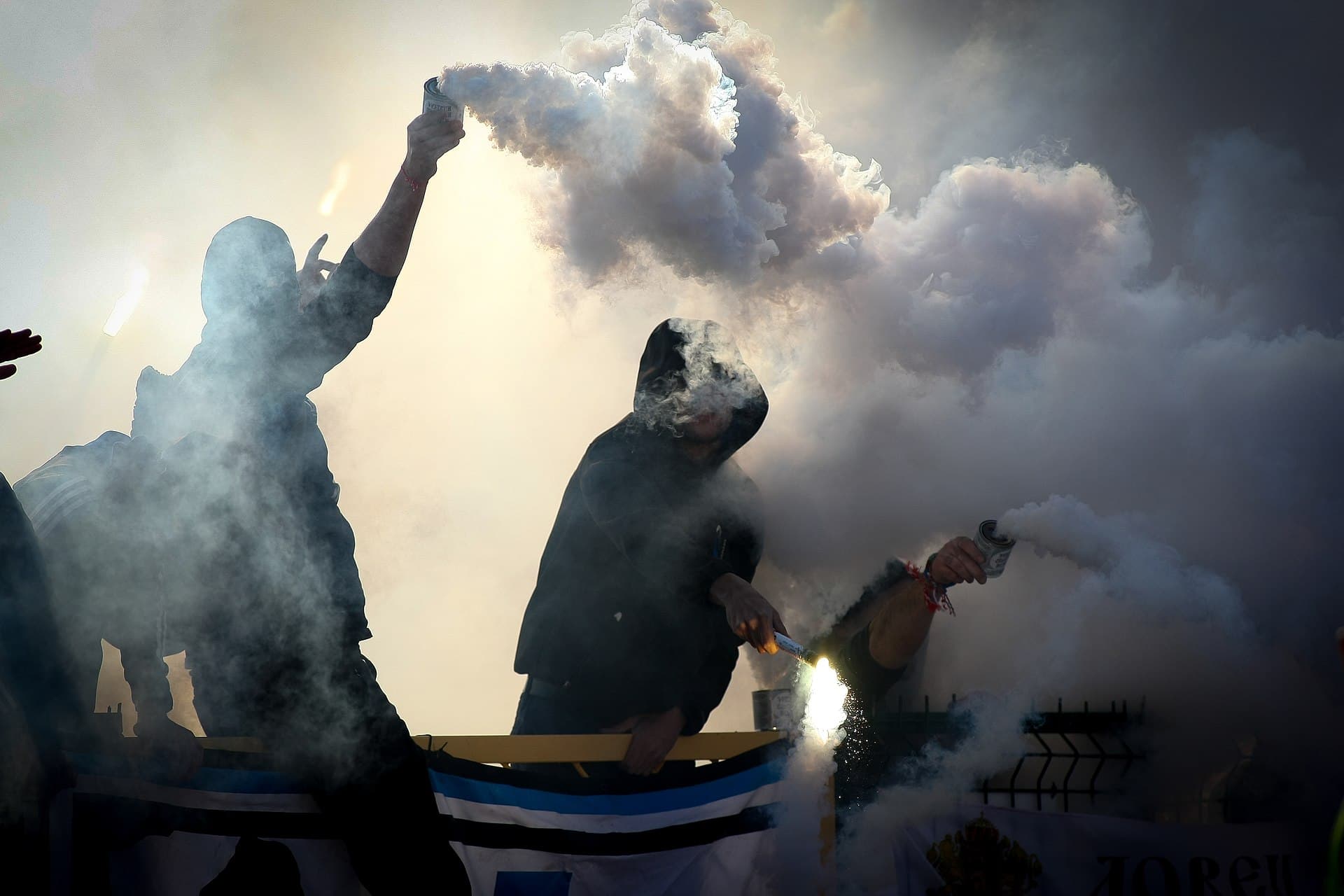
Illustrative archive photograph. Football ultras · Biso · CC BY 4.0. Framing adapted to the header. This image does not identify the group described.
At a glance
La Butteler in 30 seconds
La Butteler is the barra brava of San Lorenzo de Almagro, the organised group among the Ciclón's supporters; «La Gloriosa», by contrast, designates the fan base and not the barra. According to Infobae, its name comes from a small square between Parque Chacabuco and Boedo, renamed Enrique Santos Discépolo. The press documents leaderships since 1997, a gap in the popular stand in December 2021, an admission ban on more than 50 members in January 2026, a fight with Huracán's barras at the 2026 World Cup and an irruption at a training session in August.
- Club
- San Lorenzo de Almagro
- City
- Buenos Aires
- Stadium
- Nuevo Gasómetro (Pedro Bidegain)
- Stand
- Popular stand at the Nuevo Gasómetro
- Situation
- Three- to four-year admission ban on seven Huracán and San Lorenzo barras for the Atlanta fight (Infobae, July 2026)
Documented history
La Butteler, San Lorenzo's barra brava: name and 2026 bans
La Butteler is the barra brava of San Lorenzo. The full name «La Gloriosa Butteler» combines «La Gloriosa», which refers to the club's fan base, and «La Butteler», which according to Infobae (2021) designates the violent ones. The media report its leaderships, its relationship with the board and the events of 2026: the admission ban on more than 50 members, the Atlanta fight and the irruption at a training session.
The name: a small square between Parque Chacabuco and Boedo
According to Infobae (December 2021), «la Butteler» is the name of the Ciclón's violent ones and «owes its nickname to the small square on the border between Parque Chacabuco and Boedo», renamed Enrique Santos Discépolo. The outlet thus distinguishes the barra from the rest of San Lorenzo's fan base, made up of members and supporters with no link to it.
See this section's source ↗The leaderships from 1997 to 2019
According to Perfil 442 (November 2017), a former boss of the barra led it between 1997 and 2010. Infobae (2021) states that another leader took command of the popular stand in 2011 and that in 2017 he left the spotlight for other businesses, some tied to city politics and to the Suterh and Utedyc unions, according to the outlet. La Nación (October 2011) says the club's president met the barra's leader and said: «I have no relationship with the barras». La Nación (2015) reports incidents between that leader and police at a match.
See this section's source ↗Since 2019: a new boss and the gap in the popular stand
Infobae (2021) describes a new boss as «the capo of the blue-and-garnet stand since 2019». In December 2021, with that boss under an admission ban, the barra decided not to hang banners or enter for the match against Sarmiento, something the outlet calls unprecedented: the popular stand showed a gap in the centre. Infobae (January 2025) confirms that he is still the boss and that, in the club's political jockeying, the barra plays «to the highest bidder».
See this section's source ↗A chant that sounds like Enrique Iglesias
Récord, from Mexico, reported that La Butteler premiered a chant that resembles one of the latest hits of the Spanish singer Enrique Iglesias, «Duele el corazón». The piece does not reproduce the lyrics or say at which match it was first heard.
See this section's source ↗January 2026: the check on the barra's bus
C5N reported on 15 January 2026 that Gendarmería found drugs, a firearm and ammunition on a San Lorenzo barra bus.
See this section's source ↗World Cup 2026: trip to the United States and the Atlanta fight
Los Andes (26 June 2026) reported that 24 members of San Lorenzo's barra got through immigration controls to the United States without triggering any restrictive alert, and that the front-line bosses did not appear in the photos. According to Infobae (30 July 2026), the National Directorate for Security at Sporting Events applied an admission ban of between three and four years to seven Huracán and San Lorenzo barras for a fight in Atlanta during the World Cup.
See this section's source ↗August 2026: the irruption at the training session
Infobae (13 August 2026) says that, after the defeat against Huracán, the barra showed up at the auxiliary pitch and stopped the squad's practice. El Gráfico specifies that more than fifty members of La Butteler burst into the training session to demand answers.
See this section's source ↗Frequently asked questions
Getting to know La Butteler
What is La Butteler?
It is San Lorenzo's barra brava, the organised group of the Ciclón's violent ones according to Infobae, and not the club's whole fan base.
What is the difference between La Gloriosa and La Butteler?
«La Gloriosa» refers to San Lorenzo's fan base; «La Butteler» designates, according to Infobae (2021), its barra brava. The name «La Gloriosa Butteler» brings them together.
Where does the name come from?
From a small square between Parque Chacabuco and Boedo, renamed Enrique Santos Discépolo, according to Infobae (2021).
Who leads it?
According to Infobae (January 2025), its boss is still the one Infobae (2021) describes as in command since 2019. Los Andes (June 2026) mentions that the front-line bosses did not appear in the World Cup photos.
Is there an admission ban?
Infobae reported in 2021 that its boss had an admission ban. The sources consulted do not specify the later situation of the other members.
What happened in Atlanta?
According to Infobae, a fight with Huracán's barras during the 2026 World Cup; seven of them received an admission ban of between three and four years.
What happened after the defeat against Huracán in 2026?
The barra burst into a squad training session and stopped the practice, according to Infobae; El Gráfico speaks of more than fifty members.
What is its relationship with the club?
According to La Nación (2011), the then president met the barra's leader and denied any relationship with the barras; Infobae (2025) states that in the club's internal politics the barra plays «to the highest bidder».
When was La Butteler founded?
No press source consulted dates its founding. Perfil (2017) reports that a boss led it between 1997 and 2010; earlier stages are not documented in this article.
Where is it located at the Nuevo Gasómetro?
Infobae (December 2021) speaks of the Ciclón's popular stand, where the barra left a gap in the centre; no source consulted specifies the end.
Is an ideology attributed to La Butteler?
No source consulted attributes an ideology to the barra. Infobae (2021) links a former boss with businesses tied to city politics and to unions, and the same outlet (2025) says it plays «to the highest bidder» in club politics; these are links, not an ideological position.
Sources
The documents behind this history
Each source keeps its date and scope. Titles appear in their original language. An insider account, an announcement and an official decision document different facts.
- De mecánico a jefe de la barra de San Lorenzo: quién es el hombre por el que la popular del Ciclón lució un hueco en el centro ↗
Infobae · Gustavo Grabia · 1 December 2021
Origin of the name, leaderships since 2011 and the gap in the popular stand in December 2021.
- San Lorenzo: una barra brava que ganó poder en los últimos años ↗
La Nación · 27 October 2011
Relationship between the club's president and the barra's leader.
- Fue detenido Sandokán, el líder de la barra brava de San Lorenzo ↗
La Nación · 4 October 2015
Incidents between the leader and police at a match in 2015.
- Polémica por la boda de un exbarra en el club | 442 ↗
Perfil 442 · 22 November 2017
Leadership of a former boss between 1997 and 2010.
- Radiografía del 2025 de las barras del fútbol argentino: las internas que están a punto de explotar ↗
Infobae · Gustavo Grabia · 16 January 2025
The barra's boss in 2025 and his role in the club's internal politics.
- Hinchas de San Lorenzo... y de Enrique Iglesias ↗
Récord (México)
A La Butteler chant resembling an Enrique Iglesias hit.
- Drogas, un arma de fuego y municiones: el hallazgo de Gendarmería en un micro de la barra de San Lorenzo ↗
C5N · 15 January 2026
Drugs, a firearm and ammunition found on the bus.
- Barras bravas en el Mundial 2026: La Butteler de San Lorenzo lidera la tribuna argentina en EE.UU. ↗
Los Andes · Redacción Deportes · 26 June 2026
Trip of 24 members to the 2026 World Cup with no immigration alert.
- Sancionaron con derecho de admisión a los barras de San Lorenzo y Huracán que se pelearon en el Mundial: nombres y antecedentes ↗
Infobae · Gustavo Grabia · 30 July 2026
Fight in Atlanta and three- to four-year admission bans on seven barras.
- La barra de San Lorenzo irrumpió en plena práctica del plantel tras la derrota ante Huracán: “La próxima no venimos a charlar” ↗
Infobae · Gustavo Grabia · 13 August 2026
Irruption at the training session after losing to Huracán.
- Detalles exclusivos de la visita de la barra de San Lorenzo al plantel ↗
El Gráfico · Silvio Maverino · 13 August 2026
More than fifty members at the training session.
Documentary review: 23 October 2026. English edition: 21 October 2026. Editorial team: Mundo Ultras.
Keep reading