Boca Juniors · Buenos Aires
La 12
La 12 is the barra brava of Boca Juniors: origin of the name, leadership, court cases and admission bans, according to Infobae, La Nación and TyC Sports.

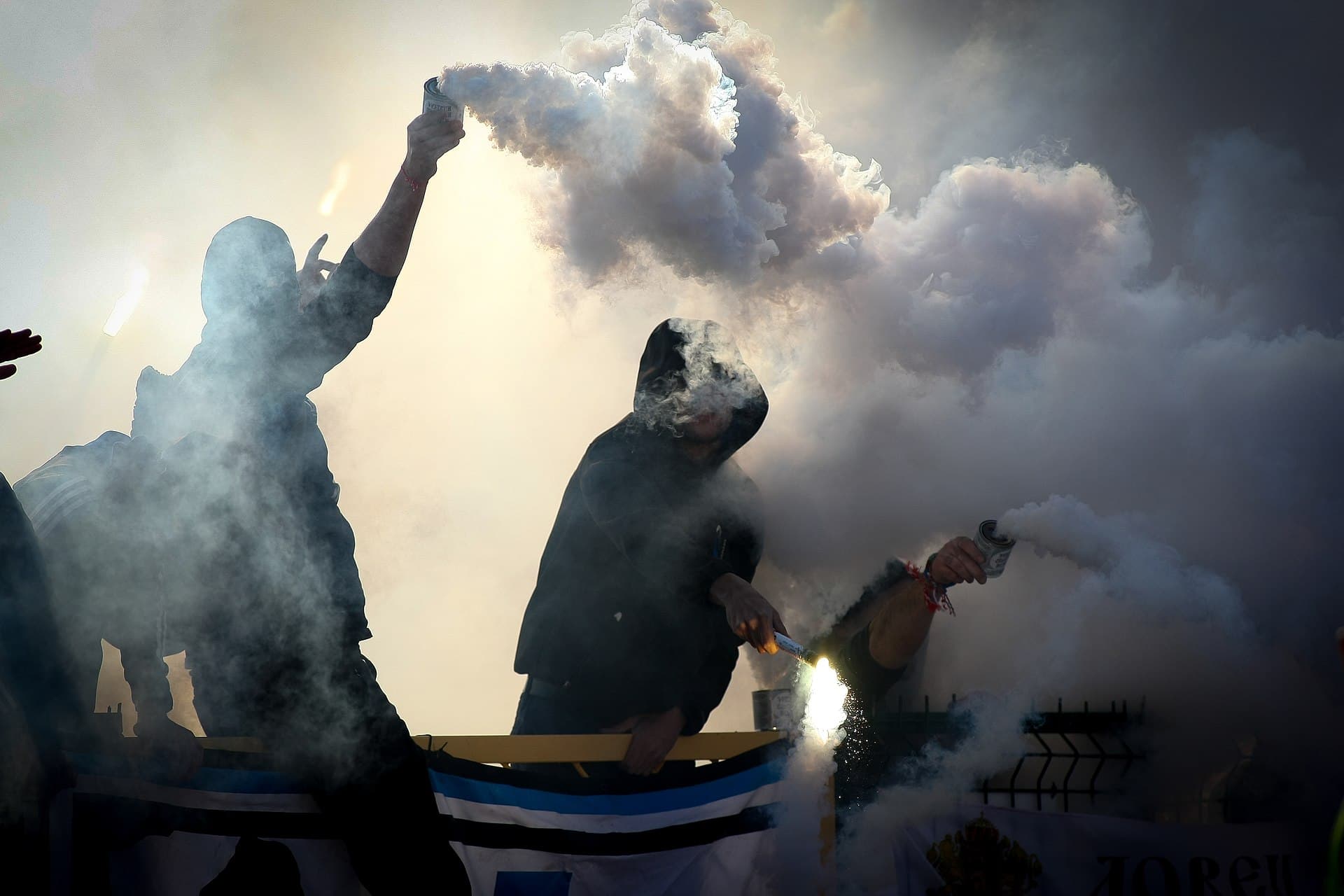
Illustrative archive photograph. Football ultras · Biso · CC BY 4.0. Framing adapted to the header. This image does not identify the group described.
At a glance
La 12 in 30 seconds
La 12 is the barra brava of Boca Juniors, the organised group among the xeneize supporters, distinct from the club's fan base as a whole at La Bombonera. Its name refers to the «Jugador Número 12», the nickname that a scorer in the tournament gave to a fan on the 1925 European tour, according to TyC Sports. Infobae places the group's origin in 1969 as «La Barra de Cocusa» and a founding moment in 1981; the press later reports internal disputes over the leadership, convictions, admission bans and a trip to the 2025 Club World Cup without its main leaders.
- Club
- Boca Juniors
- City
- Buenos Aires
- Stadium
- La Bombonera (Alberto J. Armando)
- Stand
- The stand facing Casa Amarilla · La Bombonera
- Situation
- Admission ban on a historic leader, in force since November 2024 (El Doce, April 2026)
Documented history
La 12, Boca Juniors' barra brava: history and admission bans
La 12 is the name by which the barra brava of Boca Juniors is known. It should be told apart from the fan base: the «Jugador Número 12» began as the nickname of a supporter in 1925 and the barra adopted it later, without the sources dating when. Infobae traces its evolution from the «La Barra de Cocusa» of 1969 to the later leaderships, and La Nación describes its stand and its banners at La Bombonera. Court episodes and admission bans are reported with the outlet that tells them and their date.
From the «Jugador Número 12» to the name of the barra
TyC Sports reports, in a feature from December 2021, that the nickname «Jugador Número 12» was born during Boca's European tour in 1925: one of the tournament's scorers gave it to a fan who accompanied the team. The name of the fan base, and by extension of La 12, comes from that expression. The article explains the origin of the supporter's nickname; it does not date the moment when the barra adopted the name.
See this section's source ↗From «La Barra de Cocusa» to prison (1969–1994)
According to Infobae (2007), after the titles of 1969 a group formed that was called «La Barra de Cocusa». In 1973 a leader nicknamed «El Carnicero» appears who, according to the same outlet, was the «capo» for almost the whole decade. Infobae (2009) places a «founding moment» of the barra brava in 1981, with the arrival of a new leader who created the «Fundación Jugador Número 12» to raise money. In 1994, after an ambush on River fans that left two dead, several barras were jailed, among them that leader, whom Infobae describes as convicted of unlawful association.
See this section's source ↗The leaderships from 1995 to 2015
Infobae (2007) notes that the leadership passed to another figure with experience in the barra; according to Infobae (2009) he arrived with his brother. Letra P (2018) states that he was in prison between 2007 and 2011 for attacking the Chacarita barra during a friendly at La Bombonera in 1999. Infobae (2009) speaks of a «fierce internal dispute» over the leadership, and La Nación (2011) recounts his return to La Bombonera with some 900 people, with two parallel barras on the terraces. In January 2015, according to Diario de Cuyo, the club's president said they were going through «a very difficult moment with the barra».
See this section's source ↗Banners and stand at La Bombonera
La Nación (2011) places La 12 in the «historic stand» facing Casa Amarilla. Among the banners it describes are «Jugador Nº 12 Pte. Los dueños de la historia» and «Como no somos los únicos, decidimos ser los mejores», which it presents as the flag for the big occasions, such as the Superclásicos. The same text says that, in 2011, the two parallel barras «never agreed on what to sing». Infobae (2025) adds that the paravalanchas is the axis of its power.
See this section's source ↗Admission bans and amparos (2016–2023)
According to Infobae (January 2025), the barra's power has rested since 2016 on the pair formed by its two historic leaders. Diario de Cuyo recalls that in 2017 the Ministry of Security banned them from entering stadiums and that, in September 2022, a judge authorised their entry to La Bombonera through an amparo, which the Ministry appealed. An administrative measure and the court ruling in a specific case have different scopes and are not equivalent to a criminal sentence.
See this section's source ↗2024–2026: Tribuna Segura and the Club World Cup
Infobae (January 2025) states that the barra «keeps its unity» after the admission bans for the incidents against Gimnasia in the Copa Argentina. According to El Doce, one of its historic leaders has had an admission ban in force since November 2024, under the Tribuna Segura programme; on 2 April 2026 he was stopped at Córdoba airport and notified. Infobae and La Nación (June 2025) document La 12 in Miami during the Club World Cup, with about 15 members led by second-rank figures and without its three main leaders. For the 2026 World Cup, Infobae (June 2026) reports that neither of the two historic leaders planned to travel to the United States.
See this section's source ↗Ideology and identity · La 12
La Nación (31 October 2011) describes, in the section of La 12 that one of its leaders then ran, «a caricature on a white background of the late former president Néstor Kirchner, with the legend “Nunca te olvidaremos”». It is a banner observed by the outlet at a specific match: it is not a statement by the group, does not prove a political affiliation and does not describe the position of Boca's fan base. The sources consulted do not record an ideological self-definition of the barra.
Source of this description ↗Frequently asked questions
Getting to know La 12
What is La 12?
La 12 is the barra brava of Boca Juniors, the organised group among the supporters, and it is not the same as the club's whole fan base. Its name comes from the «Jugador Número 12», a nickname born in 1925 among the fans, according to TyC Sports.
Where does the name «La 12» come from?
From the nickname «Jugador Número 12», which according to TyC Sports a scorer in the tournament gave to a fan during Boca's European tour in 1925. The source does not date when the barra adopted it.
When was La 12 formed?
Infobae places the formation of a group called «La Barra de Cocusa» in 1969 and the founding moment of the barra brava in 1981. The sources consulted do not fix a formal founding date.
Where is La 12 located at La Bombonera?
According to La Nación (2011), in the historic stand facing Casa Amarilla. Infobae (2025) adds that the paravalanchas is the axis of its power.
Who leads La 12?
According to Infobae (January 2025), power has rested since 2016 on a pair of historic leaders. One of them has had an admission ban in force since November 2024 (El Doce, April 2026) and the other «has no restriction», according to Infobae (June 2026).
Have leaders of La 12 been convicted?
Infobae (2009) describes a former leader as convicted of unlawful association, and Letra P (2018) states that another leader was in prison between 2007 and 2011 for an attack in 1999. These are facts about specific individuals, not about the whole barra or Boca's fan base.
Does it have friendships with other fan groups?
La Nación (2011) reports that the friendship between Vélez's fans and Boca's barra is well known.
Does La 12 travel to international tournaments?
Yes. At the 2025 Club World Cup there was a delegation of about 15 members in Miami, without its main leaders, according to Infobae and La Nación.
Does La 12 have a declared ideology?
The sources consulted do not record an ideological self-definition of La 12 or a general attribution. La Nación (October 2011) described, in its section, a banner with a caricature of Néstor Kirchner and the legend «Nunca te olvidaremos»; it is a banner observed at one match, not an affiliation of the group.
Who are La 12's rivals?
No source consulted documents, with a date and a subject, a rivalry between La 12 and any specific barra. Infobae (2007) recounts a 1994 ambush on River fans that left two dead and La Nación (2011) cites the Superclásico as the occasion for the biggest display of banners, but these are isolated events, not a rivalry attributed to the barra by the media.
Sources
The documents behind this history
Each source keeps its date and scope. Titles appear in their original language. An insider account, an announcement and an official decision document different facts.
- La triste célebre historia de los capos de la 12 ↗
Infobae · 22 March 2009
The 1981 stage, the founding of the fundraising group, the conviction for unlawful association and the internal dispute over the leadership.
- Los líderes de ?La 12?, con el correr del tiempo ↗
Infobae · 23 May 2007
Origins from 1969 to 1994 and the change of leadership.
- La historia detrás del Jugador Número 12 de Boca Juniors - TyC Sports ↗
TyC Sports · Bianca Soifer · 23 December 2021
Origin of the nickname «Jugador Número 12» on the 1925 European tour.
- Impunidad y poder en la barra brava de Boca ↗
La Nación · 31 October 2011
The Casa Amarilla stand, banners, parallel barras and friendship with Vélez's fans.
- Angelici: “Estamos pasando un momento muy difícil con la barra” ↗
Diario de Cuyo · 6 January 2015
The club president's statements on the relationship with the barra and the admission ban.
- ¿A qué juegan? ↗
Letra P · 9 December 2018
A leader of the barra in prison between 2007 and 2011.
- La Justicia autorizó que Di Zeo y Mauro Martín ingresen a la Bombonera ↗
Diario de Cuyo · 8 September 2022
The 2022 amparo and the 2017 admission ban.
- Radiografía del 2025 de las barras del fútbol argentino: las internas que están a punto de explotar ↗
Infobae · Gustavo Grabia · 16 January 2025
Overview of the barras in 2025: power shared since 2016, the paravalanchas and unity after the admission bans.
- Quiénes son los barras de “La Doce” que estuvieron en el debut de Boca Juniors por el Mundial de Clubes ↗
Infobae · Gustavo Grabia · 18 June 2025
Presence of the barra in Miami during the Club World Cup.
- Quiénes son los barraravas que siguen a Boca hasta que quede eliminado del Mundial de Clubes ↗
La Nación · Leandro Contento · 19 June 2025
Delegation in Miami without its main leaders.
- La 12 en Córdoba: encontronazo de Rafa Di Zeo en el Aeropuerto y drogas y puntas en los controles ↗
El Doce (Córdoba) · 2 April 2026
Admission ban in force since November 2024 under Tribuna Segura and the operation in Córdoba.
- Cuáles son las barras que buscan dominar la tribuna de la selección argentina en el Mundial: los nombres prohibidos ↗
Infobae · Gustavo Grabia · 9 June 2026
Situation of its two historic leaders ahead of the 2026 World Cup.
Documentary review: 23 October 2026. English edition: 21 October 2026. Editorial team: Mundo Ultras.
Keep reading