At a glance
Indar Gorri in 30 seconds
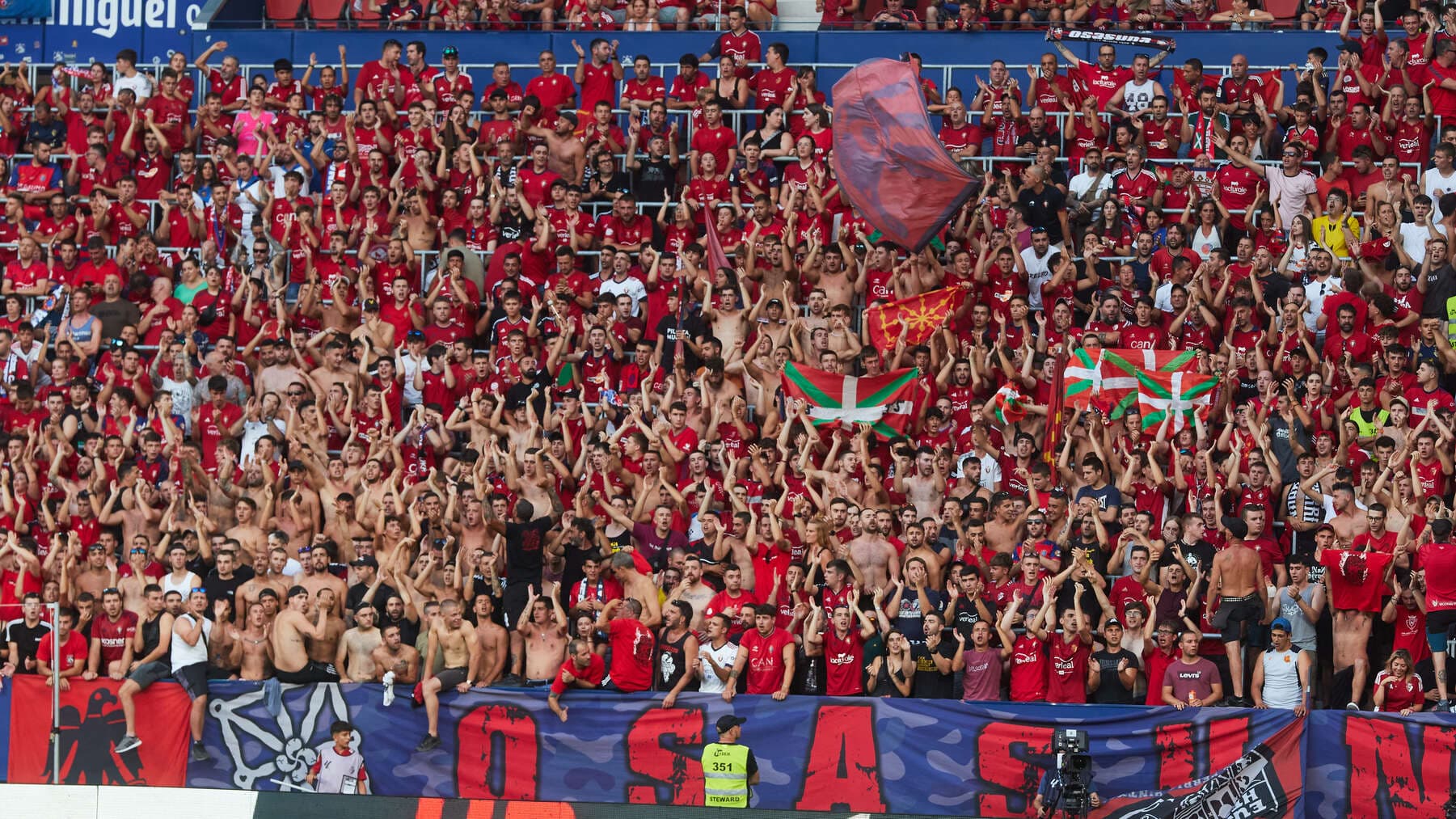
Indar Gorri is the animation group of Graderío Sur at El Sadar, among Osasuna's supporters. It was born in late 1987, when two cuadrillas (groups of friends) joined together as a form of self-defence and animation, and unveiled its first banner on 13 December against Sabadell. Its name means «red strength» in Basque. Over the last decade it has accumulated fines, arrests and court cases with differing outcomes, and in March 2026 it was still calling protests from Graderío Sur.
- Club
- CA Osasuna
- City
- Pamplona
- Stadium
- El Sadar
- Stand
- Graderío Sur at El Sadar
- Founded
- 1987
- Situation
- Twelve-minute silent protest in Graderío Sur (March 2026)
Documented history
Indar Gorri: Osasuna's Graderío Sur group since 1987
Natxo Matxin's report for GARA of December 2017 records the origin of Indar Gorri among two cuadrillas of Osasuna fans who, in late 1987, decided to found a collective as a form of self-defence, protest and animation. One of its founders recalls that they were some fifteen supporters of Preferencia Cubierta who planned to move to the north end and ended up in Graderío Sur.
1987: self-defence, flares and a banner without a logo
According to GARA, the two founding cuadrillas were fed up with the treatment they received in nearby stadiums and created the collective as a form of self-defence, protest and animation. The first banner, hung on 13 December 1987 during an Osasuna–Sabadell match, did not yet carry the characteristic logo the group adopted later, and its debut was accompanied by a display of flares.
See this section's source ↗Symbols, fines and courts
The members interviewed by GARA in 2017 placed around the turn of the century the ban on bringing in certain symbols, a ban they said they had overturned in the courts, and then a period of fines, including a mass penalty for a trip to El Sardinero. On 1 February 2024, NAIZ reported that the group claimed to have received more than 200 fines since the opening of the stand with rail seating and announced that it would leave Graderío Sur empty for the first seven minutes against Celta and Cádiz, in solidarity with seven season-ticket holders sanctioned with a month without access to the ground.
See this section's source ↗Sadar Bizirik and members' participation
In 2017, its members described their work in the Sadar Bizirik platform alongside the Federación de Peñas Osasunistas, Osasuna 2020, Eman Egurre, Peña Lizarra and Gorriak on Tour, and their participation in the club's assembly of delegates. Among the achievements they claimed were the change of statutes, the recognition of bilingualism in the club and the declaration of Javier Tebas as persona non grata. For their 30th anniversary they organised a concert at the Errotxapea gaztetxe, reissued old material and held a «bengaleo» (flare display) behind closed doors at El Sadar.
See this section's source ↗2016–2018: Operation Basatiak and conviction for criminal group membership
In February 2016, eighteen members of Indar Gorri were arrested in Operation Basatiak («savages» in Basque) and released with charges of belonging to a criminal group. In May 2018, eleven defendants admitted the facts and Criminal Court no. 4 of Pamplona sentenced them to one year in prison for that offence, according to nuevecuatrouno.
See this section's source ↗2022–2025: arrests, a dismissal and a conviction
After incidents with Biris Norte members in Pamplona in September 2023, the National Police arrested nine members of the group. In March 2024, another operation over the incidents before the Betis–Osasuna match of October 2023 ended with 61 members arrested in Navarre, and groups such as Iraultza 1921, Herri Norte and Riazor Blues publicly expressed their support. In February 2025, Examining Court no. 7 of Seville provisionally dismissed that case as it could not identify the perpetrators. The same month, a court in Burgos sentenced six members of Indar Gorri and five of Resaca Castellana to four months and fifteen days in prison and a ban on attending sporting events over a fight with Real Zaragoza ultras in November 2022.
See this section's source ↗2026: silence in Graderío Sur and a proposed closure
In March 2026, the Graderío Sur sector announced twelve minutes of silence against Girona in protest at the police charges at El Sadar, according to Noticias de Navarra. On 4 June, the Commission against Violence proposed closing El Sadar for two months and fining the club 200,000 euros over what happened at the open training session on 22 May; Osasuna called the proposal unfair and disproportionate. It is a proposal, not a final penalty, and the club's statement does not name the group.
See this section's source ↗Key dates
Timeline of Indar Gorri
1987 · Foundation and first banner
Two cuadrillas found the collective; the first banner appears on 13 December against Sabadell.
2016 · Operation Basatiak
Eighteen members are arrested and released with charges of belonging to a criminal group.
2017 · Thirty years
Concert at the Errotxapea gaztetxe, reissue of material and a celebration at El Sadar.
2018 · Conviction for criminal group membership
Eleven members admit the facts and are sentenced to one year in prison.
2024 · Protest against fines
Graderío Sur is left empty for seven minutes against Celta and Cádiz; 61 members are arrested in March.
2025 · Dismissal and conviction
The Seville case is provisionally dismissed; six members are convicted over a fight with Ligallo in Burgos.
2026 · Silence and proposed closure
Twelve minutes of silence against Girona in March; in June the closure of El Sadar for two months is proposed.
Ideology and identity · Indar Gorri
In December 2014, a Europa Press report published by RTVE described Indar Gorri as having an abertzale (Basque left-nationalist) tradition and noted an internal faction, the Micriobotas, of a more anti-system and far-left attitude. In 2017, its members defined themselves to GARA as a «reflection of the street, of social reality» in Navarre. These are descriptions of the group at those dates, not of all Osasuna fans.
Source of this description ↗Frequently asked questions
Getting to know Indar Gorri
What does Indar Gorri mean?
«Red strength» in Basque: «indar» means strength and «gorri», red, according to the Elhuyar dictionary.
When did Indar Gorri's first banner appear?
On 13 December 1987, against Sabadell, according to the testimonies published by GARA in 2017. It did not yet carry the logo the group adopted later.
What are Osasuna's ultras called?
Osasuna's best-known animation group is Indar Gorri, founded in 1987 and located in Graderío Sur at El Sadar.
Where does Indar Gorri stand at El Sadar?
In Graderío Sur, where the group ended up in late 1987 after a first core in Preferencia Cubierta. Noticias de Navarra still identified it with that sector in March 2026.
What is Indar Gorri's ideology?
Europa Press (RTVE, 2014) attributed to it an abertzale tradition and an internal anti-system, far-left faction, the Micriobotas. In 2017 its members defined themselves as a reflection of Navarre's social reality.
Which groups does it have friendship or rivalry with?
Europa Press (2014) described a good friendship with Peña Mujika of Real Sociedad and a strong enmity with Ligallo Fondo Norte of Real Zaragoza. In 2025, six members were convicted over a fight with Zaragoza ultras in Burgos.
Have members of Indar Gorri been convicted?
Yes, in specific cases: eleven members accepted a year in prison in 2018 for belonging to a criminal group and six were convicted in 2025 over a fight in Burgos. The case over the 2023 Seville incidents was provisionally dismissed in 2025.
Is Indar Gorri still active?
Yes. In March 2026 it announced a twelve-minute silent protest at El Sadar against Girona, according to Noticias de Navarra.
Sources
The documents behind this history
Each source keeps its date and scope. Titles appear in their original language. An insider account, an announcement and an official decision document different facts.
- Así es el mapa de los ultras del fútbol español ↗
RTVE · Europa Press · 1 December 2014
Ideological description, the Micriobotas faction, friendship with Peña Mujika and enmity with Ligallo.
- Represión y trabas no impiden que Indar Gorri cumpla tres décadas ↗
GARA · Natxo Matxin · 26 December 2017
Testimonies on the origin, location, fines, Sadar Bizirik and the 30th anniversary.
- Las escuchas a los Indar Gorri detenidos desvelan conversaciones sobre el ataque a una cafetería logroñesa ↗
nuevecuatrouno · 4 February 2016
Arrests in Operation Basatiak; these are not convictions.
- Los 'Indar Gorri' relacionados con incidentes en Logroño, condenados a un año de cárcel ↗
nuevecuatrouno · 7 May 2018
Conviction of eleven members for criminal group membership.
- Se elevan a nueve los miembros de Indar Gorri detenidos por incidentes con ultras del Sevilla ↗
Diario de Noticias de Navarra · 11 December 2023
Arrests over the incidents of 23 September 2023 in Pamplona; these are not convictions.
- Indar Gorri dejará vacío Graderío Sur de El Sadar los 7 primeros minutos contra las multas ↗
NAIZ · 1 February 2024
Call for a protest and complaint about fines; not a sanctioning ruling.
- Se elevan a 61 los miembros de Indar Gorri detenidos por los incidentes del Betis–Osasuna ↗
Diario de Noticias de Navarra · Enrique Conde · 7 March 2024
Arrests over the incidents before Betis–Osasuna and support from other groups.
- Archivan la causa contra 61 miembros de Indar Gorri ↗
Diario de Noticias de Navarra · Enrique Conde · 5 February 2025
Provisional dismissal of the Seville case.
- Cuatro meses de cárcel y prohibición de acceso a estadios a seis miembros de Indar Gorri ↗
Diario de Noticias de Navarra · 12 February 2025
Burgos ruling over the 2022 fight with Real Zaragoza ultras.
- 12 minutos en silencio ante el Girona: la medida de Indar Gorri ↗
Diario de Noticias de Navarra · Diego Eusa · 19 March 2026
Protest announced from Graderío Sur in 2026.
- Statement on Proposed Sanction by the Anti-Violence Commission ↗
CA Osasuna · 4 June 2026
The club's position on the proposed closure of El Sadar; it does not name the group. Article in English.
- indar (diccionario euskera-castellano) ↗
Elhuyar
Meaning of «indar»: strength.
- rojo (diccionario castellano-euskera) ↗
Elhuyar
Translation of «rojo»: gorri.
Documentary review: 18 October 2026. English edition: 21 October 2026. Editorial team: Mundo Ultras.
Keep reading