
At a glance
Boixos Nois in 30 seconds
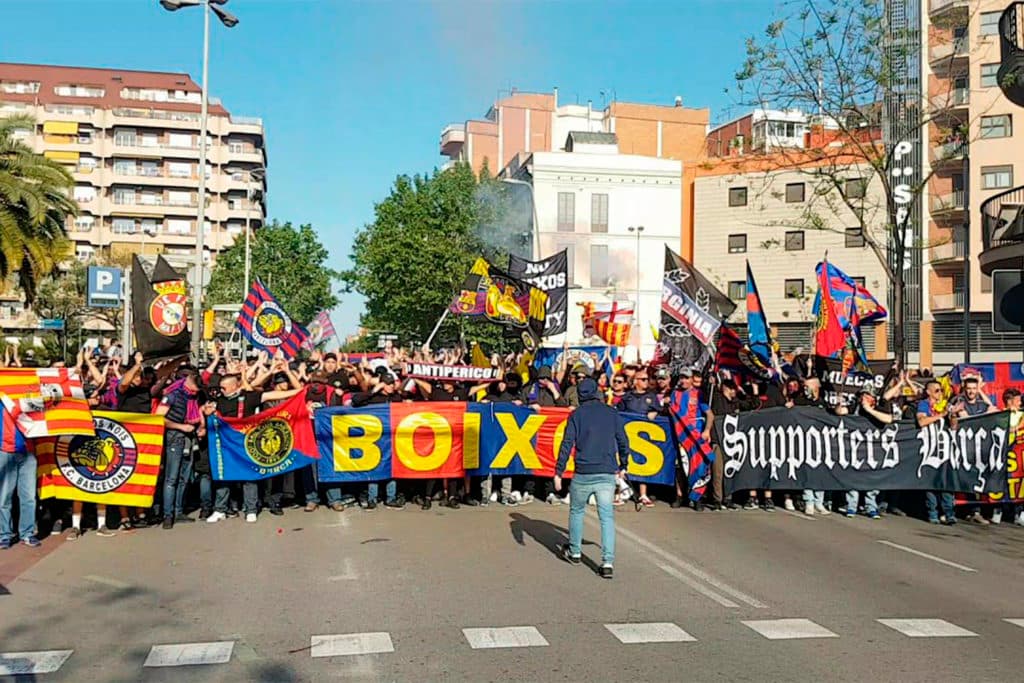
Boixos Nois is an FC Barcelona ultra group born in 1981 that occupied Gol Nord at the Camp Nou until its expulsion in 2004. It emerged with a pro-independence, left-wing profile and, according to El País, from the late 1980s took in neo-Nazi sectors. In 1991 five of its members killed a young Espanyol fan next to the old Sarrià stadium. Joan Laporta expelled it from the stadium between 2003 and 2004, and in 2019 the Anti-Violence Commission declared it a «dangerous group».
- Club
- FC Barcelona
- City
- Barcelona
- Stadium
- Camp Nou
- Stand
- Gol Nord at the Camp Nou (until 2004)
- Founded
- 1981
- Relationship with the club
- Banned from the Camp Nou in 2003–2004; declared a dangerous group in 2019
Documented history
Boixos Nois: history of Barça's ultra group and its expulsion from the Camp Nou
Boixos Nois emerged in 1981 and for more than two decades occupied Gol Nord at the Camp Nou. Its history combines stand animation with an ideological evolution away from its pro-independence, left-wing origins, episodes of violence such as the death of an Espanyol fan in 1991 and the break with FC Barcelona, which expelled it from the stadium in early 2004.
1981–1990: origin and Gol Nord
La Soga's retrospective places the birth of Boixos Nois in 1981 and mentions as a forerunner some young fans called Los Morenos; the group was part of the first Spanish expansion of ultra culture, before the 1982 World Cup. El País described it in 1998 as born «with a pro-independence and left-wing outlook» and located its banners in the north goal stand of the Camp Nou. According to that report, from the 1989–1990 season neo-Nazi sectors entered the group, and in 1990 Sang Culé split off.
See this section's source ↗1991: the death of an Espanyol fan
In 1991, five members of Boixos Nois stabbed to death a 20-year-old Espanyol fan around the old Sarrià stadium. The Interior Ministry recalled it in 2021 as the first ultra death in Spain. In 1998 El País placed Espanyol among the group's two most hated rivals.
See this section's source ↗The nineties: official peña, fanzines and conflicts
El País's report of February 1998 described a heterogeneous group, not all of whose members were violent, which had been an official peña for two seasons. It mentioned its fanzines and the commemorative portrait that hung in the north goal stand. It also recounted its clashes with Sang Culé: after an assault in December 1997, this splinter group, which had 400 members, decided to disband two days later.
See this section's source ↗2003–2004: the expulsion from the Camp Nou
Joan Laporta began the expulsion on becoming president of FC Barcelona in 2003. According to RTVE, the process combined disciplinary files, expulsions and the dismantling of the facilities the group had in the stadium itself, and the actual expulsion took place in early 2004. The Interior Ministry notes that in 2003 they were denied entry to football stadiums.
See this section's source ↗After the ban: 2013–2021
In March 2013, Nació Digital reported that members of the group had again taken up positions in Gol Sud at the Camp Nou. In 2019, the Anti-Violence Commission declared Boixos Nois a «dangerous group», and on 25 January 2020 it was involved in serious clashes with Yomus in Valencia. In November 2021, the National Police arrested 14 people from its leadership and circle and seized supremacist material; according to the Interior Ministry, that faction would be the heir of those known as the Casuals. It is a police investigation, not a conviction.
See this section's source ↗Gol Nord after Boixos Nois
The Espai d'Animació was born in 2017 in Gol Nord, formed by other groups, in the area where Boixos Nois had habitually been until 2004, according to the newspaper Ara. On 26 November 2024, FC Barcelona disqualified the Espai d'Animació, then at the Estadi Olímpic de Montjuïc, for breaches of the agreements with its member groups; its statement did not mention Boixos Nois.
See this section's source ↗2025: the flag at the reopening
At the reopening of the Camp Nou, in November 2025, a Boixos Nois flag with messages against Joan Laporta was unfurled, according to Flashscore's report, which presented it as the continuation of a confrontation of more than twenty years.
See this section's source ↗Key dates
Timeline of Boixos Nois
1981 · Birth
La Soga places the group's origin in 1981, with a forerunner of young fans called Los Morenos.
1990 · Sang Culé splits off
After neo-Nazi sectors entered in 1989–1990, Sang Culé split off, according to El País.
1991 · Death of an Espanyol fan
Five members of the group stab to death a 20-year-old next to the old Sarrià.
2003 · Start of the expulsion
Joan Laporta becomes president and the club opens disciplinary files and dismantles its facilities at the Camp Nou.
2004 · Out of the Camp Nou
The actual expulsion from the stadium takes place early in the year, according to RTVE.
2019 · Dangerous group
The Anti-Violence Commission declares it a «dangerous group».
2021 · Police operation
The National Police arrest 14 people from its leadership and circle and seize supremacist material.
2025 · Flag at the reopening
On the return to the Camp Nou, in November, a flag of the group with messages against Laporta is unfurled, according to Flashscore.
Ideology and identity · Boixos Nois
The sources describe an evolution. In February 1998 El País recalled that Boixos Nois was born in 1981 «with a pro-independence and left-wing outlook» and that from the 1989–1990 season neo-Nazi and casual sectors entered the group. A degree dissertation from the University of La Laguna (2025) describes it with an «ultranationalist Catalan» identity and a radical-right position. In November 2021, the Interior Ministry reported the seizure of supremacist material in the operation against its leadership. These descriptions refer to the group and those under investigation, not to FC Barcelona's supporters.
Source of this description ↗Frequently asked questions
Getting to know Boixos Nois
When was Boixos Nois born?
In 1981, according to La Soga's retrospective, which mentions as a forerunner some young fans called Los Morenos.
What is Boixos Nois's ideology?
It has evolved: El País (1998) explains that it was born with a pro-independence and left-wing outlook and that from 1989–1990 neo-Nazi sectors entered. In 2021 the Interior Ministry reported the seizure of supremacist material in the operation against its leadership.
Where did the Boixos Nois stand at the Camp Nou?
In Gol Nord, until the club expelled them from the stadium in 2004. The Espai d'Animació, formed by other groups, was born in that area in 2017, according to the newspaper Ara.
Why did Laporta expel the Boixos Nois?
Because of their violence. FC Barcelona removed them between 2003 and 2004 with disciplinary files, expulsions and the dismantling of their facilities in the stadium, according to RTVE; the Interior Ministry notes that in 2003 they were denied entry to stadiums.
Who are Boixos Nois's enemies?
Espanyol and its fans, according to El País (1998), which placed it among their two most hated rivals; in 1991, five members of the group killed an Espanyol fan. The Interior Ministry also documents a clash with Yomus, of Valencia, in January 2020.
Do the Boixos Nois still exist?
The National Police acted against its leadership in November 2021, and at the reopening of the Camp Nou in November 2025 a flag of the group was unfurled. That display of its symbols is not equivalent to an official readmission as an animation group.
Was the closure of the Espai d'Animació in 2024 a new ban on Boixos Nois?
No. FC Barcelona's measure of November 2024 affected the Montjuïc animation space and the groups that formed it; the statement does not mention Boixos Nois.
What happened in 1991 with Boixos Nois?
Five members of the group stabbed to death a 20-year-old Espanyol fan next to the old Sarrià stadium. The Interior Ministry considers it the first ultra death in Spain.
Sources
The documents behind this history
Each source keeps its date and scope. Titles appear in their original language. An insider account, an announcement and an official decision document different facts.
- Historia del movimiento ultra en España: los orígenes (1975–1988) ↗
La Soga · Pentayus · 9 March 2015
Historical reconstruction of the first groups and their names.
- Silencio, mandan los boixos ↗
El País · Àngels Piñol, Rafael Carbonell and Manel Serras · 8 February 1998
Ideological origin, north goal stand, neo-Nazi sectors, Sang Culé, official peña and rivalry with Espanyol.
- El retorn dels Boixos Nois ↗
Nació Digital · 1 March 2013
Presence of group members in Gol Sud in 2013. Article in Catalan.
- Barça y Real Madrid, al frente de la tolerancia cero con los ultras ↗
RTVE · Rubén Heras · 1 December 2014
Expulsion process begun in 2003 and the club's measures.
- La Policía Nacional descabeza la cúpula radical del grupo Boixos Nois ↗
Ministry of the Interior · National Police · 25 November 2021
The 1991 death, the 2003 ban, the 2019 dangerous-group declaration, Mestalla 2020 and the 2021 operation. An investigation, not a conviction.
- La Policía controla a 10.000 ultras en el fútbol ↗
El Independiente · Carlos Frías · 18 February 2023
Inclusion of the group among the fifteen considered dangerous by the Anti-Violence Commission.
- El Espacio de Animación del Barça corre riesgo de desaparecer ↗
Ara · Martí Molina · 19 November 2024
Gol Nord as the group's historical location until 2004 and the origin of the Espai d'Animació in 2017.
- Comunicado del FC Barcelona sobre el Espai d’Animació ↗
FC Barcelona · 26 November 2024
Measure on the Montjuïc Espai d'Animació; the document does not mention Boixos Nois.
- Grupos ultras y la politización del fútbol en España ↗
Héctor González Borges · University of La Laguna (degree dissertation) · 2025
Academic ideological description (p. 18).
- 'Welcome home': Inside Barcelona's victorious return to fabled Camp Nou ↗
Flashscore · 22 November 2025
Group flag at the reopening of the Camp Nou. Article in English.
- El moment en què Joan Laporta es va plantejar retirar-se de la presidència del Barça ↗
RTVE · Berta Codina · 18 December 2025
Laporta's testimony; places the actual expulsion in early 2004. Article in Catalan.
Documentary review: 18 October 2026. English edition: 21 October 2026. Editorial team: Mundo Ultras.
Keep reading