At a glance
Frente Atlético in 30 seconds
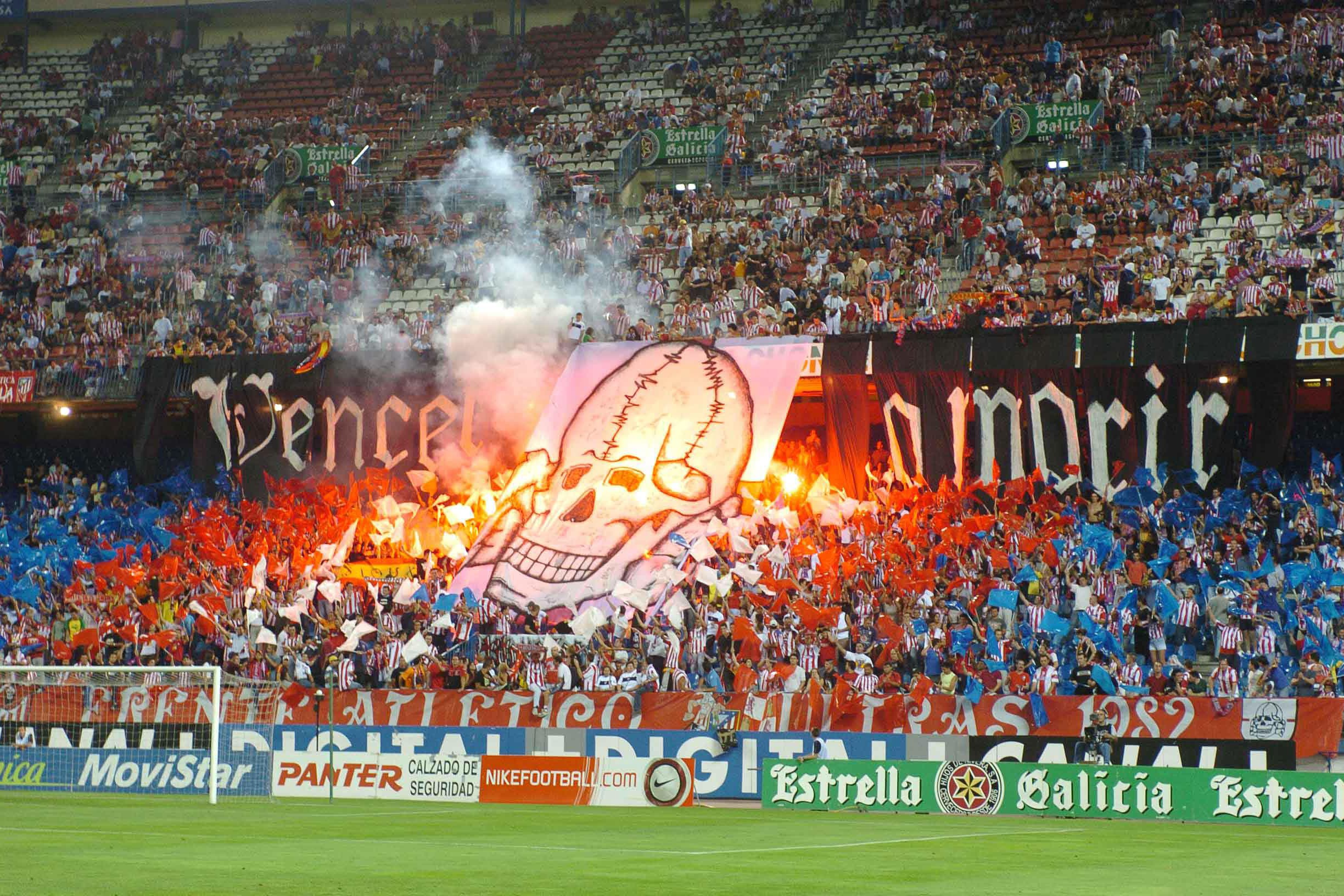
Frente Atlético is Atlético de Madrid's ultra group, founded in 1982 with forerunners in the Fondo Sur peña of the late 1960s. For decades it led the singing in the Fondo Sur of the Vicente Calderón, behind its banner «Frente Atlético Ultras Fondo Sur». After the Madrid Río brawl of 30 November 2014, in which a Deportivo fan died, the club withdrew its recognition as an official peña on 2 December and banned its insignia. In October 2024, El Debate still described it as the group that runs the animation stand in the Metropolitano's south end.
- Club
- Atlético de Madrid
- City
- Madrid
- Stadium
- Metropolitano
- Stand
- Fondo Sur of the Metropolitano (animation stand, 2024) · Fondo Sur of the Vicente Calderón (historical)
- Founded
- 1982
- Relationship with the club
- Withdrawn as an official peña (2014)
Documented history
Frente Atlético: from the Calderón's Fondo Sur to the Metropolitano
Frente Atlético was born in 1982 and developed its history in the Fondo Sur of the Vicente Calderón. La Soga and Europa Press date its foundation to that year, with forerunners in the Fondo Sur peña of the late 1960s. The Europa Press report published by RTVE in 2014 described its roots in that sector and characterised its leaders at the time as far-right.
The Fondo Sur forerunners
The collective's own history traces its forerunners to the 1968–1969 season, when young people from different Madrid neighbourhoods gathered with large flags behind the goal; from this, according to that account, came the embryo of the group's banner. It recalls the black berets with the initials F. S., the Rubén Cano peña of 1977–1978, which it describes as «Europeanised» but not ultra, and the appearance of smoke canisters at a derby in December 1980. This is the group's own version; La Soga also places its forerunners in the Fondo Sur peña of the late sixties.
See this section's source ↗Chants, banners and fanzine at the Calderón
In her study of March 2004, Teresa Adán described the groundwork behind the Fondo Sur's animation: chants, banners, drums and megaphones. She also documented the free distribution of the Frente Atlético fanzine on matchdays, as a way of communicating activities to its followers. The observations belong to the Vicente Calderón era.
See this section's source ↗Friendships and enmities
In December 2014, Europa Press, in a report published by RTVE, described Frente Atlético's only official twinning, with Psycho Fans of Poland's Ruch Chorzów, and a good relationship with Ultra Boys of Sporting and Supporters Gol Sur of Betis. The same text placed it strongly at odds with Biris Norte, Riazor Blues and Ultras Sur. In 2017, Iraultza 1921 of Alavés chanted «Frente Atlético, asesino» (“Frente Atlético, murderer”), according to LaLiga, and in 2024 El Independiente spoke of the brotherhood with Supporters Gol Sur as something from years ago.
See this section's source ↗2014: internal division
In the autumn of 2014 the group was going through an internal confrontation arising from the friendships some of its members had with members of Ultras Sur, according to Europa Press. In March 2024, El Independiente identified Suburbios Firm as a faction that left Frente Atlético because of those friendships.
See this section's source ↗December 2014: withdrawal as an official peña
After the events at Madrid Río, Atlético announced on 2 December 2014 the removal of Frente Atlético as an official peña, the expulsion as members of the people identified in the police report and the withdrawal of the group's insignia. The other season-ticket holders of the Grada Joven kept their seats that season, and the club specified that legally dissolving an association was beyond its powers. In the first home match after the decision, against Villarreal on 14 December, the Calderón's Fondo Sur stayed silent, according to Público.
See this section's source ↗From the Calderón to the Metropolitano
The withdrawal of recognition did not make the group disappear: in February 2017, LaLiga recorded a banner of about four metres reading «Frente Atlético» in the away section at Mendizorroza. In February 2023, El Independiente cited it among the fifteen groups that the Anti-Violence Commission considered dangerous and violent. In October 2024, El Debate described Frente as the group that runs the animation stand in the Metropolitano's south end, explained that its banner «Frente Atlético Ultras Fondo Sur» had not been seen since 2014 and attributed to it initiatives such as the tifos. After objects were thrown from the lower south end in the derby of 29 September 2024, the Competition Committee ordered the partial closure of sectors 127 to 133; the ruling does not name the group.
See this section's source ↗Key dates
Timeline of Frente Atlético
1968 · Forerunners in the Fondo Sur peña
Young people from different neighbourhoods gather with large flags behind the goal, according to the collective's account.
1982 · Founded
Frente Atlético is born in the Fondo Sur of the Vicente Calderón.
2004 · Stand culture
Teresa Adán documents its chants, banners, drums and the distribution of the fanzine at the Calderón.
2014 · Withdrawn as an official peña
On 2 December, after the Madrid Río brawl, the club removes it as a peña and bans its insignia.
2017 · Banner at Mendizorroza
LaLiga records a «Frente Atlético» banner in the away section of Alavés's stadium.
2024 · Partial closure of the south end
After the derby of 29 September, the Competition Committee orders sectors 127 to 133 of the Metropolitano closed.
Ideology and identity · Frente Atlético
The Europa Press report published by RTVE in December 2014 stated that Frente Atlético's leaders «profess a far-right ideology». The degree dissertation by Baltasar Barceló Sánchez (Miguel Hernández University, 2023) likewise classifies it as far-right. These descriptions refer to the group and its leaders, not to Atlético's supporters as a whole; no political self-definition by the collective is on record.
Source of this description ↗Frequently asked questions
Getting to know Frente Atlético
In what year was Frente Atlético founded?
In 1982, according to La Soga and Europa Press. The collective's account places its forerunners in the Fondo Sur peña of the 1968–1969 season.
Which team does Frente Atlético support?
Atlético de Madrid. It led the singing in the Fondo Sur of the Vicente Calderón and, according to 2024 press reports, remains in the south end of the Metropolitano.
What is Frente Atlético's ideology?
Far-right, according to Europa Press (2014), which attributed it to its leaders, and a degree dissertation from Miguel Hernández University (2023). No political self-definition by the group is on record.
Where do Atlético's ultras stand at the Metropolitano?
In the south end. El Debate described Frente Atlético in October 2024 as running the animation stand there; before that it occupied the Fondo Sur of the Vicente Calderón.
What did Atlético decide in December 2014?
It withdrew its recognition as an official peña, expelled as members the people identified in the police report and banned its insignia. The other season-ticket holders of the Grada Joven kept their seats.
Does Frente Atlético still exist?
Yes. Although the club withdrew its recognition as a peña in 2014, the press and LaLiga documented its activity in 2017 and 2024.
Who is Frente Atlético twinned with?
With Psycho Fans of Poland's Ruch Chorzów, its only official twinning according to Europa Press (2014), which also attributed to it a good relationship with Ultra Boys of Sporting.
Who are Frente Atlético's rivals?
In 2014, Europa Press cited Biris Norte, Riazor Blues and Ultras Sur. Iraultza 1921 of Alavés directed hostile chants at it in 2017, according to LaLiga.
What is Frente Atlético's connection to the death of Jimmy?
The Madrid Río brawl of 30 November 2014, in which a Riazor Blues member died, pitted members of Frente against the Deportivo group. Two days later, Atlético withdrew Frente's status as an official peña.
Sources
The documents behind this history
Each source keeps its date and scope. Titles appear in their original language. An insider account, an announcement and an official decision document different facts.
- Orígenes e Historia ↗
Frente Atlético · the collective's account
Fondo Sur forerunners in 1968–1969, the Rubén Cano peña and the first smoke canisters. The group's own version.
- Ultras. Culturas del fútbol, pp. 92–93 ↗
Teresa Adán · Revista de Estudios de Juventud 64 · Injuve · 2004-03
2004 study of chants, organisation and distribution of the fanzine in the Fondo Sur.
- Así es el mapa de los ultras del fútbol español ↗
RTVE · Europa Press · 1 December 2014
Foundation in 1982, its leaders' ideology, twinning with Psycho Fans, friendships, enmities and internal division.
- El Atlético de Madrid expulsa al Frente Atlético ↗
Club Atlético de Madrid · 2 December 2014
Removal as an official peña, expulsion of identified members and withdrawal of insignia.
- Cisma en la grada rojiblanca ↗
Público · 14 December 2014
First match without Frente in the Calderón's Fondo Sur.
- Historia del movimiento ultra en España: los orígenes (1975–1988) ↗
La Soga · Pentayus · 9 March 2015
Foundation in 1982 and forerunners in the Fondo Sur peña.
- Nota informativa de denuncias ↗
LaLiga · 2 February 2017
Frente banner at Mendizorroza and chants by Iraultza 1921.
- La Policía controla a 10.000 ultras en el fútbol ↗
El Independiente · Carlos Frías · 18 February 2023
Inclusion among the fifteen groups considered dangerous by the Anti-Violence Commission.
- La evolución de la violencia ultra en el fútbol español ↗
Baltasar Barceló Sánchez · Miguel Hernández University (degree dissertation) · 2023
The author's ideological classification.
- Ultras del Atlético de Madrid y Betis se enzarzan en una batalla campal ↗
El Independiente · 3 March 2024
Brawl with United Family, the Suburbios Firm split and the past brotherhood with Supporters Gol Sur.
- Radiografía del Frente Atlético: los ultras que tienen secuestrado el Metropolitano ↗
El Debate · 2 October 2024
Presence in the Metropolitano's animation stand, banner and tifos.
- El Comité de Competición cierra parcialmente el Metropolitano durante tres partidos ↗
El Debate · 2 October 2024
Partial closure of sectors 127 to 133 of the lower south end after the 2024 derby.
Documentary review: 18 October 2026. English edition: 21 October 2026. Editorial team: Mundo Ultras.
Keep reading