At a glance
Celtarras in 30 seconds
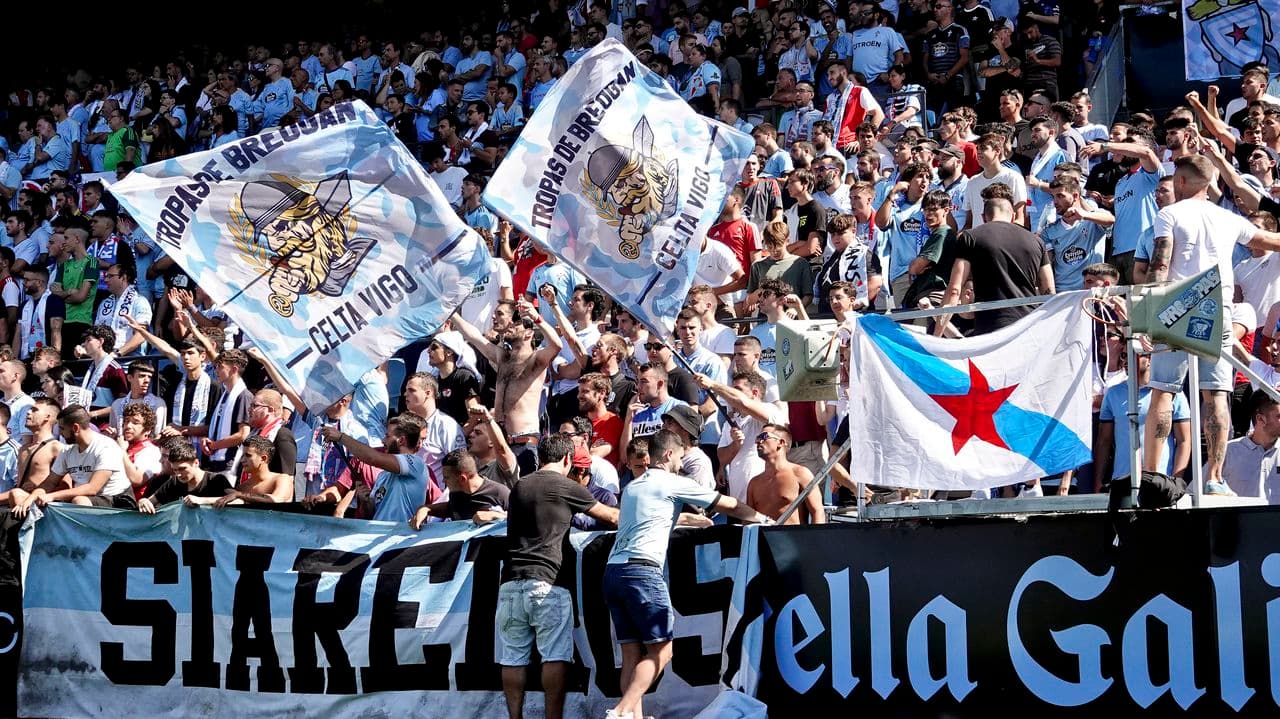
Celtarras was an RC Celta supporters' group born in 1987 on the Gol stand at Balaídos, among friends from the Maristas school and young people met on away trips, and moved soon afterwards to Fondo, today's Marcador Bajo stand. It defined itself by its commitment to the Galician nation and its anti-fascist militancy, and was twinned with Herri Norte, of Athletic. It announced its dissolution on 22 March 2019, after 32 years, citing the loss of members, fines and weariness with the commercialisation of football.
- Club
- RC Celta
- City
- Vigo
- Stadium
- Balaídos
- Stand
- Gol and Fondo (today's Marcador Bajo stand) at Balaídos · historical locations
- Founded
- 1987
- Track record
- Dissolution announced (2019)
Documented history
Celtarras: Celta's supporters' group between 1987 and 2019
Celtarras began in 1987 as a group of friends who went to Balaídos together. In Atlántico's retrospective of February 2025, one of its founders recalls a core of twelve or fifteen young people from the Maristas school, joined by fans met on away trips. They stood in Gol, in the corner with Tribuna, above the old tunnel through which the players came out.
From away trips to the move to Fondo
The account gathered by Atlántico recalls a trip to Riazor as one of the moments when more people began to join. After two or three years, two of its members took the name to Fondo, later identified as Marcador Bajo. The first core, according to that recollection, had no president and no formal peña structure.
See this section's source ↗Flares, marches and concerts
The 2019 farewell statement, reported by Faro de Vigo, summed up three decades in the stands with references to the group's demonstrations, gatherings, marches, flares and concerts. According to the same text, Celtarras became a reference point within celtismo and the main source of animation at Balaídos.
See this section's source ↗Friendships and rivalries
A report by Europa Press published by RTVE in December 2014 described Celtarras as twinned with Herri Norte, of Athletic, and at odds with Riazor Blues, of Deportivo. The undergraduate thesis of Baltasar Barceló Sánchez (Universidad Miguel Hernández, 2023) maintained that rivalry, added that of the Sporting ultras and placed the group as aligned with the Peña Mujika, of Real Sociedad, and with Herri Norte.
See this section's source ↗2019: Galician identity and farewell
On 22 March 2019, Celtarras announced its dissolution after 32 years, with the slogan «Por Galiza e polo Celta. Celtarras por sempre», according to VigoÉ. Faro de Vigo reported that the statement recalled a group of friends who in 1987 wanted to assert their sky-blue fandom, their commitment to the Galician nation and their anti-fascist militancy. It explained that many members had left the group for family or work reasons or because of «disproportionate fines», and it expressed the weariness of the veterans with the commercialisation of football.
See this section's source ↗After the dissolution
In February 2022, La Vanguardia reported a fight around Balaídos between members of Bukaneros, of Rayo Vallecano, and «a group of Celtarras». No source consulted documents a formal re-founding of the group: in February 2025, Atlántico described it as a peña that has «already disappeared» and placed Celta's animation stand in Marcador Bajo, a stand the club had added to its season-ticket campaign in 2023.
See this section's source ↗Key dates
Timeline of Celtarras
1987 · Birth in Gol
A group of friends from the Maristas school and young people met on away trips begin to call themselves Celtarras.
1990 · Move to Fondo
After two or three years, the name moves to Fondo, today's Marcador Bajo stand, according to Atlántico.
2014 · Twinning with Herri Norte
Europa Press describes its twinning with Herri Norte and its enmity with Riazor Blues.
2019 · Dissolution
On 22 March it announces its dissolution after 32 years at Balaídos.
2022 · Fight with Bukaneros
La Vanguardia reports a fight next to Balaídos between Bukaneros and «a group of Celtarras».
Ideology and identity · Celtarras
The undergraduate thesis of Baltasar Barceló Sánchez (Universidad Miguel Hernández, 2023) classifies Celtarras as a far-left group. In its farewell statement of March 2019, reported by Faro de Vigo and VigoÉ, the group itself asserted its commitment to the Galician nation and its anti-fascist militancy. The first is an external classification; the second is a self-definition by the group, not by all Celta supporters.
Source of this description ↗Frequently asked questions
Getting to know Celtarras
When was Celtarras born?
In 1987, according to the accounts of its founders gathered by Atlántico and the 2019 farewell statement.
What are Celta's ultras called?
The historic group was Celtarras (1987–2019). In 2025, Atlántico placed the club's animation stand in Marcador Bajo; no cited source names a successor group.
What is Celtarras's ideology?
It defined itself by its commitment to the Galician nation and its anti-fascist militancy, according to its 2019 statement. An undergraduate thesis from the Universidad Miguel Hernández (2023) classifies it as far left.
Where did Celtarras stand at Balaídos?
First in Gol, above the old players' tunnel, and later in Fondo, today's Marcador Bajo stand, according to Atlántico's retrospective.
Does Celtarras still exist?
Not as a constituted group: it announced its dissolution on 22 March 2019, although La Vanguardia still identified «a group of Celtarras» in a fight with Bukaneros in February 2022. Atlántico described it in 2025 as «already disappeared».
Why did it announce its dissolution?
Because of the loss of members for family and work reasons and because of fines, and the veterans' weariness with the commercialisation of football, according to its March 2019 statement.
Who were Celtarras's rivals?
Riazor Blues, of Deportivo, according to Europa Press (2014) and a 2023 academic thesis. In 2022, La Vanguardia reported a fight with Bukaneros next to Balaídos.
Which groups were they twinned with?
With Herri Norte, of Athletic, according to Europa Press in 2014; the 2023 Universidad Miguel Hernández thesis adds the Peña Mujika, of Real Sociedad.
Sources
The documents behind this history
Each source keeps its date and scope. Titles appear in their original language. An insider account, an announcement and an official decision document different facts.
- Así es el mapa de los ultras del fútbol español ↗
RTVE · Europa Press · 1 December 2014
Twinning with Herri Norte and enmity with Riazor Blues in 2014.
- Celtarras anuncia su disolución tras más de 30 años de historia ↗
Faro de Vigo · 23 March 2019
Farewell statement: identity, causes and stand memories.
- Los Celtarras anuncian su disolución tras 32 años en Balaídos ↗
VigoÉ · 23 March 2019
Coverage of the group's announcement and its farewell slogan.
- Batalla campal entre ultras del Celta y el Rayo en los aledaños de Balaídos ↗
La Vanguardia · 6 February 2022
Fight between Bukaneros and a group identified as Celtarras; not a court ruling.
- La evolución de la violencia ultra en el fútbol español ↗
Baltasar Barceló Sánchez · Universidad Miguel Hernández (undergraduate thesis) · 2023
Ideological classification, rivalries and alliances according to the author (p. 20).
- Concluye la campaña de altas para la temporada 2023/24 ↗
RC Celta · 3 August 2023
Addition of the Marcador stand to Balaídos's season-ticket capacity.
- Los inicios de Celtarras ↗
Atlántico · Javier D. Campa · 20 February 2025
Retrospective on the origin, early locations and the situation in 2025.
Documentary review: 18 October 2026. English edition: 21 October 2026. Editorial team: Mundo Ultras.
Keep reading